Clinical Exercise Science, BS program guide
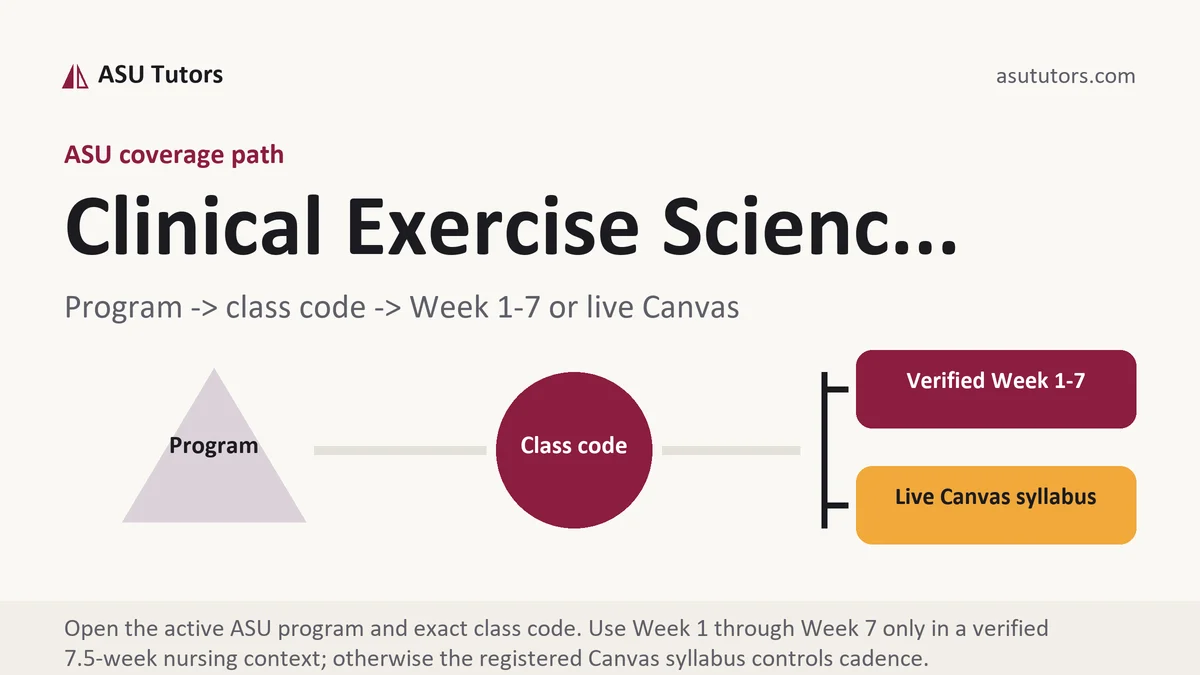
A Capella-style hierarchy adapted to ASU: current program path, exact catalog class, then verified Week links or the live Canvas control point.
This active public path exposes 66 distinct class codes across the curriculum groups below. Alternatives and electives remain under their published headings; appearance on this map is not a claim that every student takes every listed option.
Current program identity
If exercise were a pill, it would be the world's most powerful medicine. Learn how to use exercise to prevent and treat disease in this accredited program that prepares you for a career in exercise physiology or to pursue graduate study in rehabilitation sciences.
ASU Degree Search is the public identity source for this BS path and plan code ECEXERBS. Undergraduate curriculum groups come from the current 2026 checksheet; graduate class codes come from the active Degree requirements area. The Fall 2026 course catalog supplies class titles and descriptions. These layers describe public structure, not a personal enrollment contract.
Before scheduling support, reconcile this map with the current degree audit or iPOS. Confirm catalog year, campus or online modality, admission status, prerequisites, transfer work, concurrent or accelerated arrangements, electives, substitutions, clinical placement, and advisor approval. Preserve alternatives as alternatives. A course listed inside an elective group is not automatically required for every student.
The classes, one by one
Open a code for its full class guide, current catalog focus, every mapped program context, session boundary, rubric workflow, grade controls, and right-side navigation. Shared classes own one canonical page so their guidance cannot drift between degrees.
Clinical Exercise Science, BS · Major Core Courses
| Class | Fall 2026 catalog title | Credits | Cadence control |
|---|---|---|---|
| EXW 215 | Resistance Training and Recovery Techniques | 3 | Live Canvas syllabus |
| EXW 217 | Cardiorespiratory and Flexibility Training | 3 | Live Canvas syllabus |
| EXW 330 | Kinesiological Foundations of Movement | 4 | Live Canvas syllabus |
| EXW 344 | Impact of Physical Activity on Health and Disease | 3 | Live Canvas syllabus |
| EXW 420 | Exercise Testing | 4 | Live Canvas syllabus |
| EXW 427 | Exercise Prescription for Cardiometabolic Health | 3 | Live Canvas syllabus |
| EXW 484 | Internship | 3 | Live Canvas syllabus |
| KIN 101 | Introduction to Kinesiology | 3 | Live Canvas syllabus |
| KIN 290 | Introduction to Evidence-Based Practice | 3 | Live Canvas syllabus |
| NTR 290 | Introduction to Evidence-Based Research in Nutrition | 3 | Live Canvas syllabus |
| KIN 352 | Psychosocial Aspects of Physical Activity | 3 | Live Canvas syllabus |
| KIN 447 | ECG Interpretation | 3 | Live Canvas syllabus |
| SSP 315 | Exercise and Sport Physiology | 3 | Live Canvas syllabus |
| SSP 316 | Exercise and Sport Physiology Laboratory | 1 | Live Canvas syllabus |
| CHS 400 | Adaptive Exercise Program Practical Experience | 15 | Live Canvas syllabus |
| EXW 426 | Exercise for Neuromuscular Conditions | 15 | Live Canvas syllabus |
| EXW 438 | Obesity, Exercise and Health | 15 | Live Canvas syllabus |
| HEP 410 | Obesity Perspectives and Prescriptions | 15 | Live Canvas syllabus |
| KIN 442 | Fuel Metabolism | 15 | Live Canvas syllabus |
| KIN 443 | Exercise Endocrinology | 15 | Live Canvas syllabus |
| KIN 444 | Metabolic Adaptations to Exercise Training | 15 | Live Canvas syllabus |
| PRM 453 | Inclusive Community Sport | 15 | Live Canvas syllabus |
| RTH 364 | Foundations in Recreational Therapy | 15 | Live Canvas syllabus |
| RTH 384 | Recreational Therapy Practicum | 15 | Live Canvas syllabus |
| KIN 345 | Motor Behavior | 15 | Live Canvas syllabus |
| KIN 415 | Theory of Corrective Exercise | 15 | Live Canvas syllabus |
| KIN 421 | Human Motor Control | 15 | Live Canvas syllabus |
| KIN 422 | Motor Control in Special Populations | 15 | Live Canvas syllabus |
| KIN 424 | Neural Aspects of Movement and Rehabilitation | 15 | Live Canvas syllabus |
| EXW 425 | Exercise Prescription for Health and Wellness | 15 | Live Canvas syllabus |
| KIN 416 | Low Back Pain: Muscles and Movement | 15 | Live Canvas syllabus |
| KIN 460 | Theory of Strength Training | 15 | Live Canvas syllabus |
| KIN 465 | Muscle Physiology | 15 | Live Canvas syllabus |
| SSP 454 | Sports Medicine | 15 | Live Canvas syllabus |
| HSC 355 | Eating for Lifelong Health | 15 | Live Canvas syllabus |
| NTR 345 | Development of Healthy Cuisines | 15 | Live Canvas syllabus |
| NTR 353 | The Western Diet | 15 | Live Canvas syllabus |
| NTR 448 | Community Nutrition | 15 | Live Canvas syllabus |
| NTR 450 | Nutrition in the Life Cycle | 15 | Live Canvas syllabus |
| NTR 457 | Sports Nutrition | 15 | Live Canvas syllabus |
| EXW 400 | Stress Management for Wellness | 15 | Live Canvas syllabus |
| HEP 361 | Digital Health Communication and Education | 15 | Live Canvas syllabus |
| KIN 348 | Psychological Skills for Optimal Performance | 15 | Live Canvas syllabus |
| KIN 450 | Biopsychosocial Perspectives on Physical Activity and Health | 15 | Live Canvas syllabus |
| KIN 452 | Exercise Psychology | 15 | Live Canvas syllabus |
| KIN 454 | Motivational Theory in Exercise and Health | 15 | Live Canvas syllabus |
Clinical Exercise Science, BS · College of Health Solutions Requirements
| Class | Fall 2026 catalog title | Credits | Cadence control |
|---|---|---|---|
| CHS 100 | Optimizing Your Health and Performance | 3 | Live Canvas syllabus |
| CHS 300 | An Exploration of Well-Being | 3 | Live Canvas syllabus |
Clinical Exercise Science, BS · Foundational Courses
| Class | Fall 2026 catalog title | Credits | Cadence control |
|---|---|---|---|
| BIO 201 | Human Anatomy and Physiology I | 4 | Live Canvas syllabus |
| BIO 202 | Human Anatomy and Physiology II | 4 | Live Canvas syllabus |
| CHM 101 | Introductory Chemistry | 4 | Live Canvas syllabus |
| CHM 113 | General Chemistry I | 4 | Live Canvas syllabus |
| HCD 300 | Biostatistics | 3 | Live Canvas syllabus |
| PSY 230 | Introduction to Statistics | 3 | Live Canvas syllabus |
| STP 226 | Elements of Statistics | 3 | Live Canvas syllabus |
| STP 231 | Statistics for Life Science | 3 | Live Canvas syllabus |
| MAT 117 | College Algebra | 3 | Live Canvas syllabus |
| MAT 170 | Precalculus | 3 | Live Canvas syllabus |
| NTR 241 | Human Nutrition | 3 | Live Canvas syllabus |
| PSY 101 | Introduction to Psychology | 3 | Live Canvas syllabus |
Clinical Exercise Science, BS · ASU 101 or college-specific equivalent First-Year Seminar required of all first-year students.
| Class | Fall 2026 catalog title | Credits | Cadence control |
|---|---|---|---|
| CHS 101 | The ASU Experience for Health Solutions Students | 1 | Live Canvas syllabus |
Clinical Exercise Science, BS · First-Year Composition
| Class | Fall 2026 catalog title | Credits | Cadence control |
|---|---|---|---|
| ENG 101 | First-Year Composition | 6 | Live Canvas syllabus |
| ENG 102 | First-Year Composition | 6 | Live Canvas syllabus |
| ENG 105 | Advanced First-Year Composition | 6 | Live Canvas syllabus |
| ENG 107 | First-Year Composition | 6 | Live Canvas syllabus |
| ENG 108 | First-Year Composition | 6 | Live Canvas syllabus |
Program → class → Week or live Canvas syllabus
ASU uses Session A, Session B, and Session C at registration level, but a program page does not establish one universal class length. No generic Week layer is generated here. The registered schedule and Canvas syllabus control the actual cadence.
For each registered class, copy section, instructor, start and end dates, Session A, B, or C designation, due-day pattern, time zone, grading model, late policy, required technology, and final-submission window from My ASU and Canvas. Then inventory the real work: discussions, replies, quizzes, papers, cases, presentations, projects, labs, simulations, clinical or practicum records, and exam-preparation blocks.
A Week number is a position, not an assessment identity. Preserve the exact live title, directions, rubric version, template, permitted sources and tools, point value or weight, file type, deadline, and submission location before production. Announcements that amend a requirement belong in the same control packet.
Build the session board
Give every obligation one row with class code, exact Canvas label, session and Week or date, due time and time zone, points or category weight, dependency, evidence need, permitted tools, current status, feedback status, and next action. Keep different work types separate because a discussion, quantitative problem, presentation, clinical record, and proctored-exam preparation block do not share one completion test.
Work backward from the deadline. Reserve intake time for directions and rubric, evidence time for research or data, production time for the actual deliverable, and a delivery pass for citations, accessibility, filename, file type, export, and upload rendering. A 7.5-week class compresses these blocks; it does not remove them.
Reconcile after every posted result. Use raw points only when the syllabus is points-based; calculate weighted categories independently when weights control. Keep full precision until display and track any separate exam-average, clinical, competency, attendance, or progression floor as its own gate.
Turn the live rubric into acceptance tests
Directions and rubric are separate contracts. Directions control scenario, audience, length, format, source limits, tools, and submission rules. Rubric rows control scoring evidence. Translate each requirement into a yes-or-no test and assign it a visible destination in the paper, calculation, presentation, care document, project file, or discussion.
Read verbs literally. Describe requires accurate coverage; compare requires a visible basis; analyze requires relationships and implications; evaluate requires criteria and judgment; recommend requires a defensible choice tied to evidence. Universal words such as all, each, and every change the minimum complete response.
Run content quality before delivery quality. Check coverage, logic, evidence quality, calculations, and consistency across prose, tables, figures, slides, and appendices. Then check citation matching, template fields, accessibility, filename, file type, and rendered export. A polished file cannot compensate for a missing decision, and good analysis can still fail when the wrong file is uploaded.
Clinical, professional, and exam boundaries
Students perform patient care, clinical decisions, skills, simulations, laboratory activity, practicum or rotation hours, preceptor communication, signatures, experience logs, group participation, identity-verified activity, and final submission. Remove protected health, client, employee, and proprietary information before any tutoring review.
Proctored, standardized, competency, dosage-calculation, readiness, and licensure-related assessments are preparation-only. Legitimate support includes a study blueprint, practice questions, rationale review, calculation practice, concept explanation, rehearsal, and readiness decisions. It does not include entering an authenticated environment or completing the real assessment.